
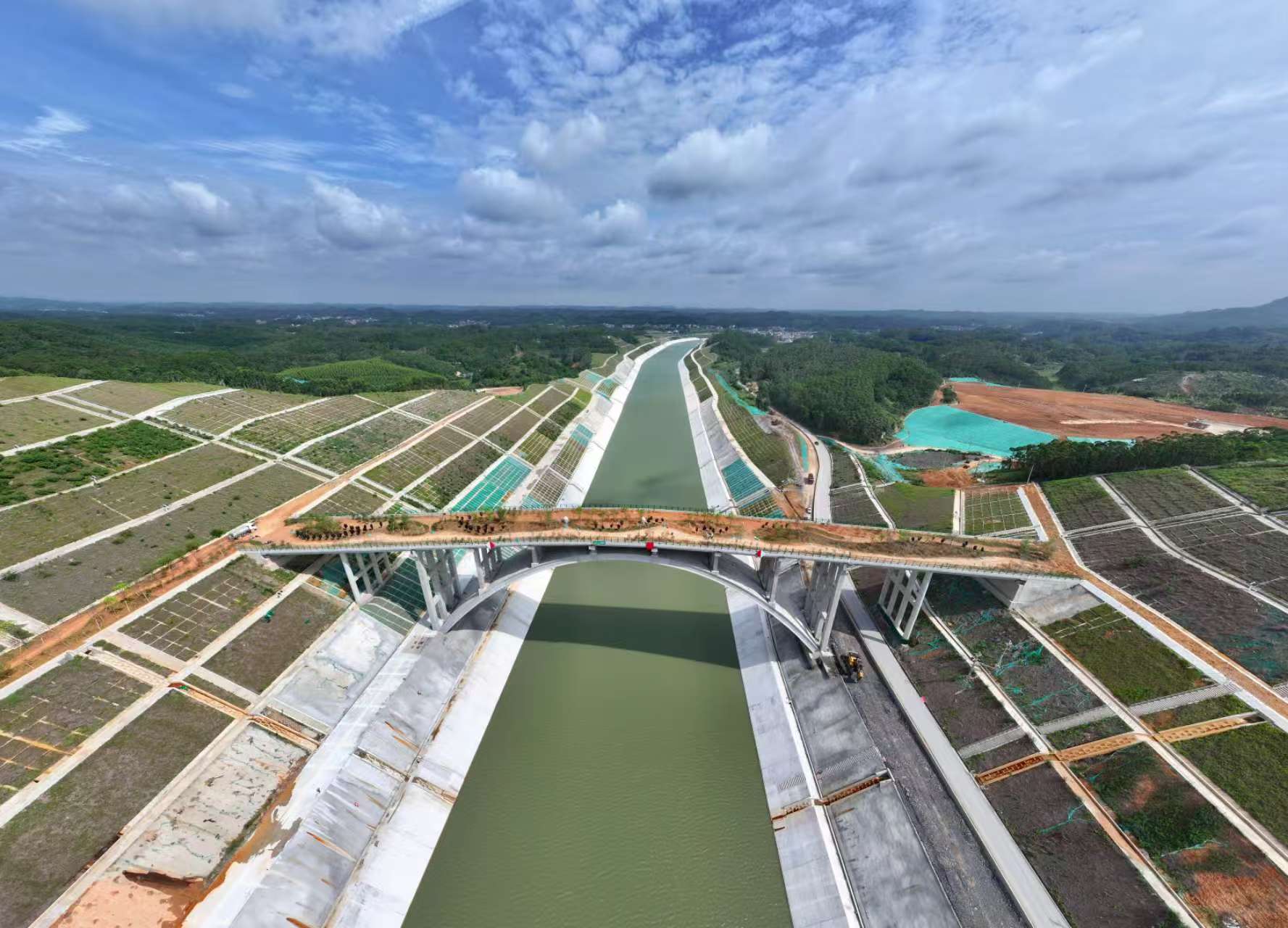
NANNING, China — The 134.2-kilometer Pinglu Canal in Guangxi will open to navigation on Sept. 16, creating a direct river-to-sea route from southwestern China to the Beibu Gulf and strengthening trade with ASEAN economies.
The canal shortens transport distances by about 560 kilometers compared with traditional routes through the Pearl River Delta and is expected to cut logistics costs by 18 to 30 percent, allowing goods from inland cities such as Nanning and Guigang to reach ASEAN markets more quickly through Beibu Gulf Port.
Philippine Ambassador to China Jaime FlorCruz, who toured the project with diplomats and envoys from ASEAN countries in July, described the canal as a strategic infrastructure project that provides a more efficient route between the Gulf and southwestern China.
“It will make transport cheaper, logistics more efficient, and allow Philippine products to get into Guangxi and other parts of China in a more efficient and cheaper way,” FlorCruz said.
He said the project is impressive because it combines flood control, irrigation, and environmental and ecological protection, making it multidimensional in purpose.
Guangxi Beihuiguixian Paper Co. chairman Chen Jin said shipments of tissue products to ASEAN markets could save 1,200 yuan to 1,500 yuan per container and arrive at least one day faster. The company already exports to Thailand and is seeking to expand sales in Vietnam and Indonesia.
Guangxi Academy of Social Sciences Southeast Asian Research Studies deputy-director Lei Xiaohua said the canal will significantly reduce logistics costs between southwestern China and ASEAN, particularly for bulk goods such as agricultural products, minerals and building materials. He added that the region’s expanding industrial base and consumer market will increase demand for ASEAN imports, supporting a mutually beneficial, two-way China-ASEAN trade relationship.
Beibu Gulf Port plans to expand two-way cargo flows with ASEAN, strengthen logistics hubs in Malaysia and Vietnam, and develop integrated river-rail-sea services. These links could also give landlocked Laos more efficient access to maritime trade through the China-Laos Railway and the New International Land-Sea Trade Corridor.
China-ASEAN trade has exceeded $1 trillion, though much of it has traditionally depended on eastern coastal ports such as Guangzhou. The Pinglu Canal is expected to diversify those routes and support a more balanced, two-way flow of goods between ASEAN and China’s southwestern provinces.
Regional regulatory and digital gaps remain a challenge. Customs procedures, inspection standards, navigation rules, terminal compatibility and digitalization levels still differ across the region, and closing those gaps will determine how much potential the canal and port system ultimately realize.
Despite those challenges, the canal’s opening is expected to strengthen Beibu Gulf Port’s position as a regional shipping hub and give businesses a shorter, lower-cost route between southwestern China and Southeast Asia. It will also deepen trade cooperation under the Regional Comprehensive Economic Partnership by combining inland waterways, rail connections and maritime shipping in a single regional logistics network.