
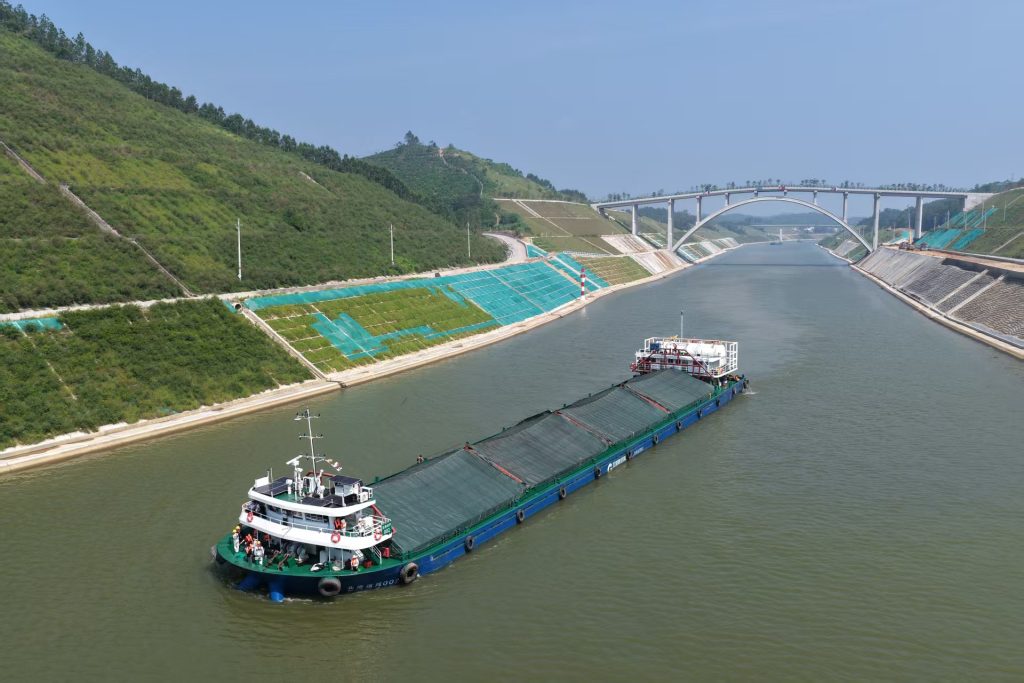
The Pinglu Canal—a flagship project of the New International Land-Sea Trade Corridor—is scheduled to open to navigation this September.
Stretching 134.2 kilometers, the canal will create the first direct river-to-sea link between the Xijiang River and the Beibu Gulf, shortening the inland waterway distance to the sea by approximately 560 kilometers and reducing overall logistics costs by an estimated 20 percent compared to traditional routes via Guangzhou Port.
From a broader supply chain standpoint, the Pinglu Canal is set to gradually transform logistics networks across the Asia-Pacific region.
By seamlessly integrating river, rail, and sea transport, the waterway will function as a high-efficiency trade artery for China-ASEAN commerce, enabling smoother outbound flows from southwest China and more efficient inbound access for ASEAN products into western China.
Historically, most cargo from China’s southwestern hinterland traveled eastward to the Pearl River Delta for export. With the canal, a new north-south logistics corridor will take shape—directly linking inland provinces such as Yunnan, Guizhou, Sichuan, and Chongqing to the Beibu Gulf and onward to ASEAN—serving as a complement to existing sea-rail freight routes.
Officials believe the Ping Lu Canal will spark new opportunities, transforming the trade landscape and enhancing economic vitality throughout Southwest China and other countries.