
Countless songs have been written about letting go and saying goodbye. As James Ingram famously sang, “there’s no easy way to break somebody’s heart.” And as it turns out, there’s no easy way to talk about it, either.
At a press conference for Teatro Kapamilya’s upcoming stage production, “The Art of Breaking Up,” the cast gave no single tidy description of what people should expect. They called it masakit, chaotic, intense, relatable, cathartic—and perhaps most surprisingly—fun and even happy.
That’s because “The Art of Breaking Up”—a reimagined adaptation of the late George de Jesus III’s Palanca-winning play “Kung Paano Maghiwalay”—isn’t so much about parting ways as it is about the imbalance left in its aftermath. Built as an anthology of non-linear vignettes, the play follows a series of interconnected stories featuring couples at various stages of unraveling.
Two sides of a split
Directed by Dudz Teraña, the show highlights the contrasting experiences of the two sides of every breakup.
There’s the bumitaw, or the one who leaves—the one burdened by guilt, “as if they had killed someone and watched the life slowly drain from the victim’s eyes”; the one who resorts to digital detachment or blocked numbers—“a coward’s exit,” as the script describes it.
Then there’s the binitawan, or the one left behind to sweep away the ghosts of unfulfilled dreams found in every corner of a home with a half-empty closet; the one who, despite the pain, is expected to suppress their anger and “remain mature and civilized.”
“Parehong masakit—‘yung bumitaw at ‘yung mabitawan,” Teraña says. “Pero personally, mas mahirap ‘yung mabitawan kasi sila ‘yung parating nagtatanong at naghahanap ng sagot.”
“Parehong masakit—‘yung bumitaw at ‘yung mabitawan… Pero personally, mas mahirap ‘yung mabitawan kasi sila ‘yung parating nagtatanong at naghahanap ng sagot”
“‘Yung bumitaw, mabilis. Before pa siya bumitaw, napag-isipan na niya kung kailan at paano niya ito gagawin. Samantalang ‘yung isa, hindi niya alam kung kailan mangyayari ‘yun. Hindi siya prepared doon. ‘Yung process ng paghahanap, doon pa lang magsisimula para sa kanya.”
Theater-in-the-round
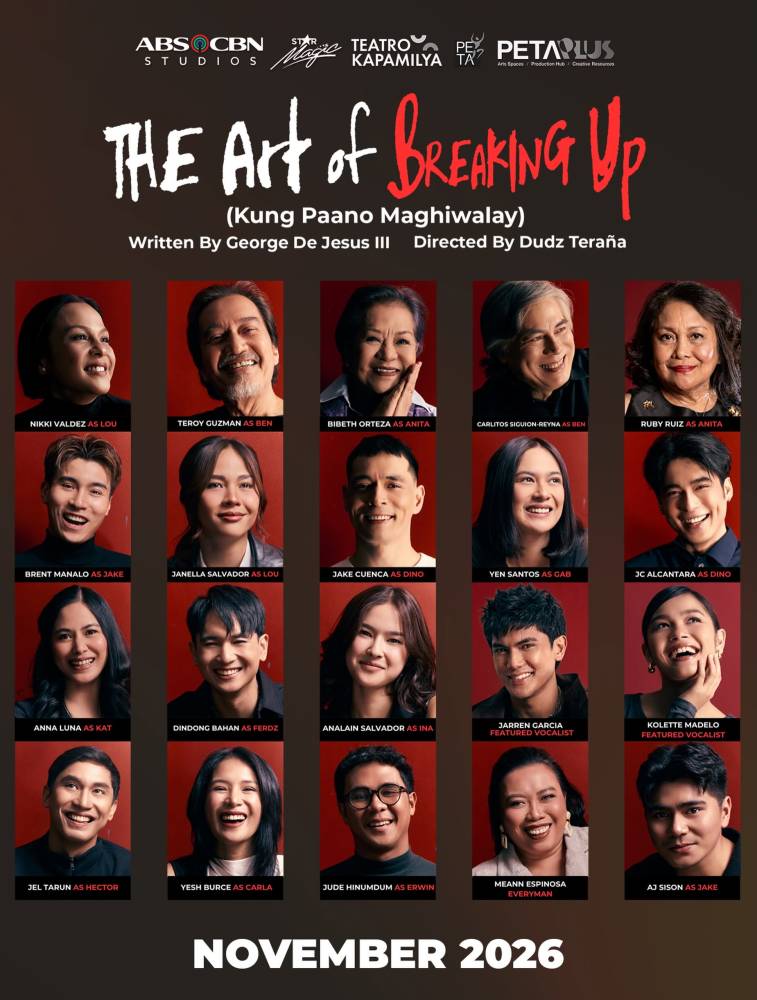
While the characters—brought to life by an ensemble cast that includes Carlitos Siguion-Reyna, Bibeth Orteza, Janella Salvador, Jake Cuenca, Nikki Valdez, Teroy Guzman, and Ruby Ruiz—may seem unrelated at first, their lives gradually overlap through family, work, and social circles. As they cross paths and exchange stories, they form a web of heartbreaks—but also moments of levity.
Teraña makes the characters even more vulnerable by staging the play in the round, which leaves the actors exposed to the audience. “You have no cover. Hubad ka, gaya ng kwento,” he says.
Meann Espinosa plays the “Everyman” device—a character tasked with guiding audiences through the play’s shifting environments and narratives. The ensemble also features Yen Santos, JC Alcantara, Brent Manalo, Anna Luna, Dindong Bahan, Analain Salvador, Jel Tarun, Yesh Burce, Jude Hinumdum, and AJ Sison. Meanwhile, Jarren Garcia and Kolette Madelo join the production as featured vocalists.
Emotional honesty
With no walls or curtains to hide behind—and no cuts to catch a breath—delivering De Jesus III’s deceptively simple but emotionally demanding lines becomes all the more challenging.
Sometimes, actors are compelled to draw from their own histories and emotions, which is an unavoidable part of the craft, Orteza points out. “Saying the lines of the people you’re portraying causes certain shifts that make you look back on your own relationships. As actors, I believe everyone will agree: Doon nanggagaling ang hugot—the sudden realization na meron na akong pinagdaanan na ganun.”
And it’s through that emotional honesty that Teraña hopes to achieve the play’s ultimate goal of blurring the line between performance and reality.
“I want to tell a truthful story. Yung mapapatanong ang tao, ‘Umaarte pa ba sila o totoo na ‘tong nangyayari sa kanila?’” he says. “The space between the actors and audience, you break that and have the people experience the breakup—para marinig, maunawaan, at mapakinggan nila.”
“I want to tell a truthful story. Yung mapapatanong ang tao, ‘Umaarte pa ba sila o totoo na ‘tong nangyayari sa kanila?’”
Breakup is a form of grief
Running from Nov. 6 to Dec. 6 at the PETA Theater Center, “The Art of Breaking Up” explores the idea that if love is “an art—messy and beautiful”—then perhaps breaking up can be, too. And if there’s a way to win someone’s heart and build a relationship, is there also a way to end one?
For Cuenca, the answer may be that there’s no real formula after all. “I think there’s no art to it,” the actor says, describing breakups as a form of grief. “It really is a piece of you—your attachment to that person—passing away.”
Salvador echoed Cuenca’s sentiments, stressing that the pain that comes with heartbreak is something people have no choice but to endure. “Breakups are meant to be painful. You have to go through and feel every emotion,” she says.
And sometimes, even when the end feels inevitable, when the moment finally arrives to say the words out loud, the instinct is still to hold on, Ruiz adds. “Sinasabi mo sa sarili mo, ‘Ayaw ko na!’ But when it’s about to happen, parang gusto mong kumapit pa pala.”
So is it possible, then, that the art isn’t really about finding a painless way to let go, but learning how to live with what comes after? “Walang madaling paraan,” Bahan says. “Time heals everything and it takes maturity and accountability.”
“We’re humans—nagkakamali tayo. It’s how we understand things beyond what we experience.”