
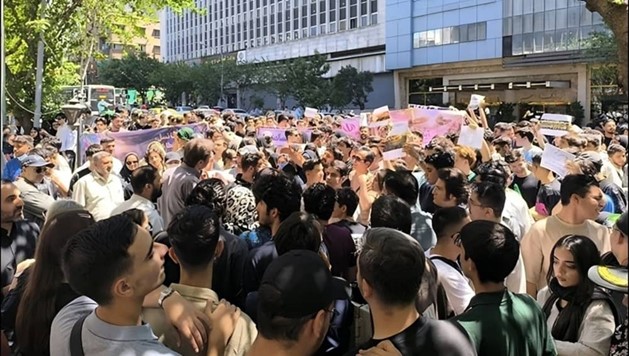
Students rally in Iran’s capital to protest changes to university entrance exam policies and academic grading systems — June 2, 2026.
Iran’s protest landscape has entered a new phase. What once appeared mainly as separate labor, pension, student, agricultural or livelihood disputes increasingly developed into a broader pattern of social unrest, culminating in a major nationwide escalation between December 22, 2025 and January 20, 2026.
According to the report, 4,229 protest events were documented between March 20, 2025 and March 20, 2026—about 8.4 percent more than the 3,902 recorded in the previous reporting period. The significance lies not only in the total but in the breadth of participation: workers, retirees, truck drivers, bakers, students, farmers, teachers and medical professionals all appeared in the record.
Workers accounted for 744 events and retirees for 597, while other groups accounted for 490. Truck drivers staged 204 protests, followed by bakers with 104 and university students with 103. The distribution indicates that dissatisfaction is not confined to a single profession, locality or social class.
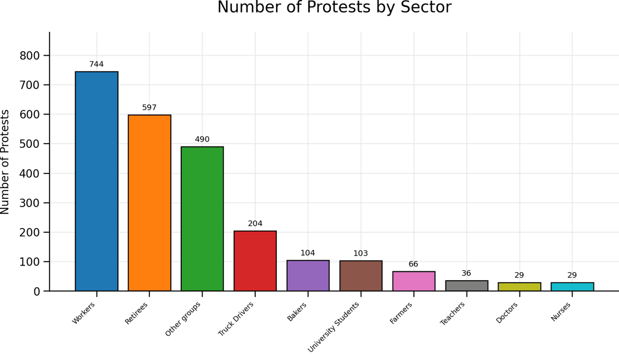
Chart 1. Number of recorded protests by sector, March 20, 2025–March 20, 2026.
The most striking development came during the nationwide escalation. Between December 22, 2025 and January 20, 2026, the report records 1,839 protest events, including 1,767 categorized as part of the nationwide uprising. This represents a structural break from the recurring pattern of sectoral protests that characterized much of the year.
The economic environment provides important context. Bread prices rose sharply: lavash from 14,000 to 27,000 rials, taftoon from 23,000 to 45,000, barbari from 53,000 to 100,000 and sangak from 74,000 to 155,000. Chicken rose from about 2.8 million to 3.58 million rials per kilogram during late April and May, while a 900-ml bottle of cooking oil was reported at around 3.48 million rials.
Housing and transport added further pressure. One estimate placed Tehran housing prices at about 980 million rials per square meter in 2024, compared with roughly 70 million in 2018. Public and intercity transport costs also increased. Although nominal minimum wages rose by about 60 percent, the report emphasizes that higher nominal income did not restore purchasing power. Inflation was estimated at around 42.2 percent for 2025, while independent estimates placed the poverty line for a four-person household well above the monthly income of many minimum-wage earners.
The report does not claim that every protest was directly caused by a particular price increase. Its broader finding is that widespread mobilization developed alongside severe pressure on food, housing, transport, employment and household purchasing power.
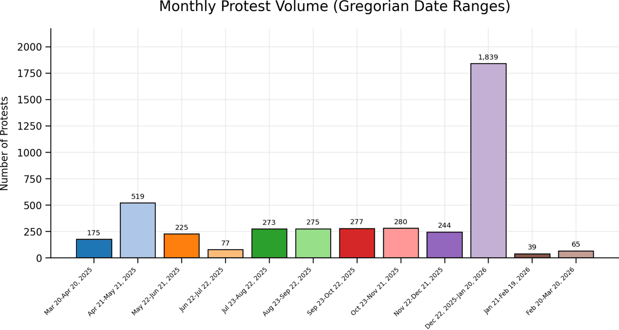
Chart 2. Monthly protest volume, highlighting the December 22, 2025–January 20, 2026 nationwide escalation.
Economic hardship, however, does not fully explain why protest persists under conditions of intense repression. The report identifies a second factor: organized opposition networks operating inside Iran. It specifically notes the activities of Resistance Units affiliated with the People’s Mojahedin Organization of Iran (PMOI/MEK), while stressing that the protest dataset was not designed to measure their precise causal contribution to the overall number of demonstrations.
According to the report, NCRI and PMOI/MEK sources have repeatedly reported Resistance Unit activities in Tehran and other cities, including actions directed against institutions and symbols associated with state repression. Their significance lies in maintaining an organized form of dissent in an environment where participation can lead to arrest, imprisonment or more severe punishment. The report also cautions that this does not mean labor, pension, student or livelihood protests were all organized or directed by the PMOI/MEK.
The other side of the equation is the state’s expanding security response. Following the January uprising, authorities introduced extensive checkpoints, patrols, restrictions on movement, curfews and mass arrests. Executions, death sentences and imprisonment form part of a wider deterrence environment. Protest therefore continues despite conditions deliberately designed to make public mobilization difficult and dangerous.
For Turkey, these developments have a direct regional dimension. Iran’s internal stability affects cross-border trade, transportation, migration pressures, energy relations and Turkey’s wider security calculations. A prolonged cycle of unrest and repression could complicate Ankara’s dealings with Tehran, while any substantial political change in Iran would affect the regional balance, including Turkey’s relations with the South Caucasus and the wider Middle East. These developments also have a direct human dimension for Iranians living in Turkey, who closely follow events in Iran and may be affected by changes in security, migration and cross-border relations.
Iran’s 2025–2026 protests should therefore not be viewed as a collection of isolated economic complaints. They represent a wider social and political crisis in which economic hardship, declining purchasing power, unemployment and dissatisfaction interact with organized opposition activity and an increasingly coercive state apparatus.
The central question is no longer simply how many protests Iran has experienced. It is whether accumulated social grievances, nationwide mobilization and organized resistance can develop into a sustained political challenge—and how the Iranian state and its regional neighbors respond.
Conclusion: The 4,229 protests documented for the reporting period reveal an unusually broad protest landscape, culminating in the December 22, 2025–January 20, 2026 nationwide uprising. The pattern points to a society under sustained socioeconomic pressure while political and organized forms of dissent continue to operate under intense repression. The significance of the current protest wave therefore lies not only in its scale, but in the possibility that dispersed grievances can continue to converge into a broader national challenge.