
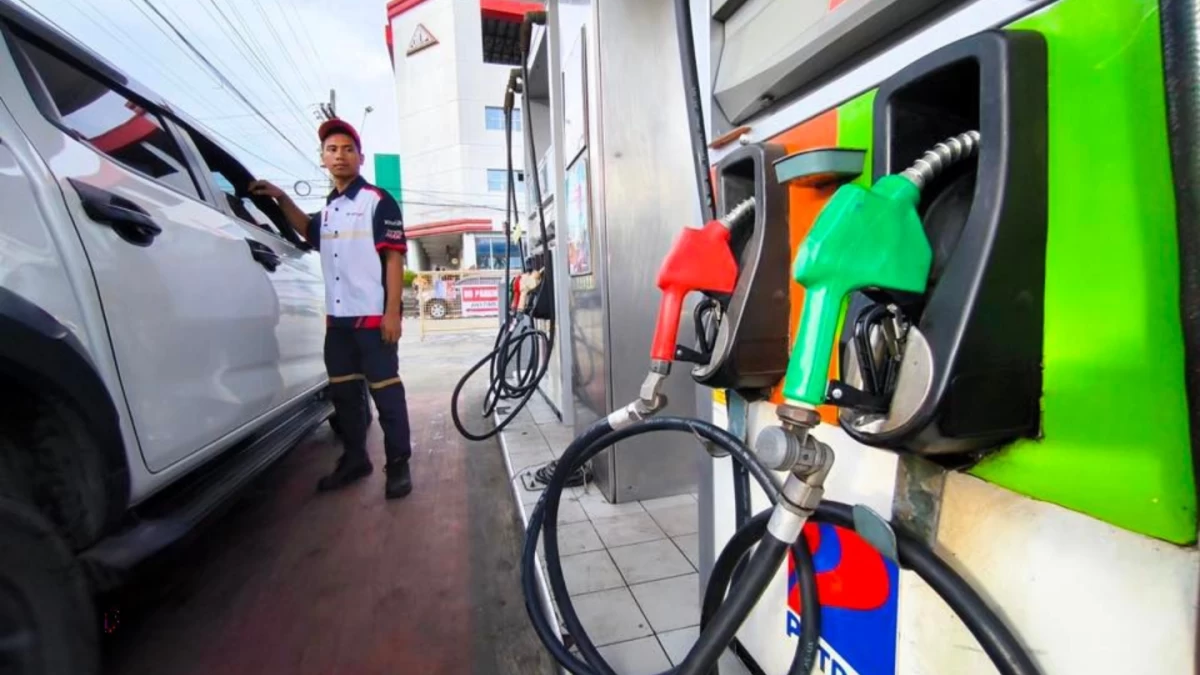
A gas station attendant refuels a vehicle in Iloilo City on Monday, March 9. While this fuel was purchased at lower rates weeks ago, retailers have raised prices to reflect “replacement costs”—the higher price they must pay to restock inventory amid global supply fears. (Photo by Tara Yap I MB)
The Department of Energy (DOE) warned Monday, March 16, that the surge in fuel prices may persist indefinitely, even as the government secures commitments from oil retailers to spread out price increases to shield consumers from sudden rate shocks.
In a briefing, Energy Secretary Sharon Garin announced that petroleum products are slated for their second consecutive week of double-digit increases this year, with diesel prices bearing the brunt of the adjustment.
Effective Tuesday, March 17, through March 23, diesel prices will climb by ₱20.4 to ₱23.9 per liter, a move expected to severely impact the operating costs of public utility vehicles such as jeepneys and buses.
Gasoline prices are projected to rise by ₱12.9 to ₱16 per liter, while kerosene—which recorded the steepest spike last week—will see a moderated increase of ₱6.9 to ₱8.9 per liter.
Garin cited the continued volatility in the retail landscape, noting that diesel prices could reach ₱94 to ₱114 per liter at some stations.
She explained that for a station selling at ₱70 per liter last week, the highest adjustment could bring the price to ₱94 per liter.
To mitigate the immediate impact on motorists, the DOE has coordinated with major players, including Shell Pilipinas, Petron Corp., Seaoil, Total, Flying V, and Jetti Petroleum, to implement staggered price tranches over two to three days.
These prices follow movements in the Mean of Platts Singapore (MOPS), a regional benchmark affected by recent geopolitical tensions and logistical disruptions that hamper the normalization of premiums.
Local rates remain under pressure from geopolitical tensions and logistical bottlenecks that have prevented the normalization of premiums.
Garin noted that while the department remains hopeful for eventual rollbacks, the outlook depends heavily on stability in the Middle East.
Tensions involving Iran near the Strait of Hormuz—a critical chokepoint through which approximately 85 percent of oil exports to Asia pass—continue to disrupt global supply chains.
Despite concerns about domestic inventory, Garin assured the public that the Philippines maintains an ample supply of fuel and urged against hoarding or panic buying.
She confirmed that the government is exploring alternative suppliers and has held discussions with the Department of Finance to establish credit facilities for oil firms. These financial instruments are intended to help retailers offset losses and manage rising premium costs.
The DOE is also evaluating the role of biofuels in the energy mix. While the mandatory biodiesel blend remains unchanged for now, Garin suggested that firms might voluntarily increase their blend limits if supply allows, which could benefit the local coconut industry.
The Philippine Biodiesel Association is currently lobbying for a mandate to increase the blending rate to seven percent, arguing that a higher domestic blend would reduce reliance on volatile fuel imports and stabilize the local copra-coconut oil value chain.