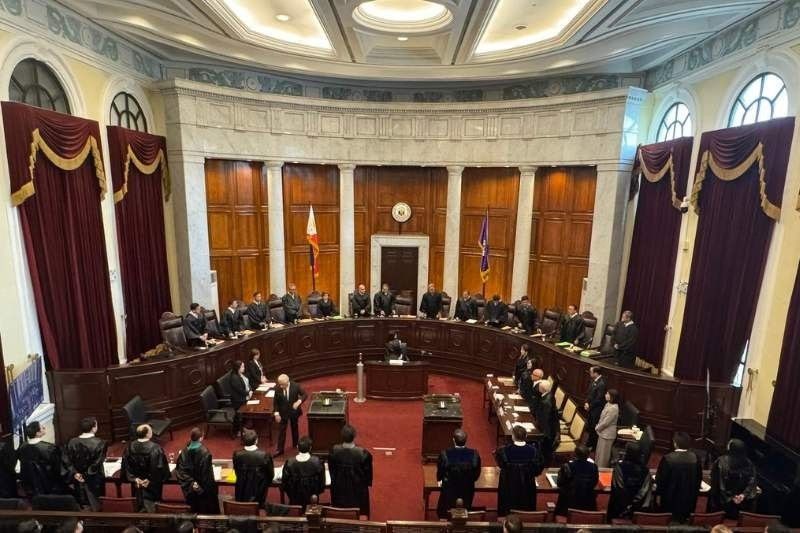
MANILA, Philippines — The Supreme Court has ordered the government to return the P60 billion it withdrew from the excess reserve funds of the Philippine Health Insurance Corp. (PhilHealth) in 2024, spokesperson Camille Ting announced on Friday, December 5.
Speaking at a press briefing, Ting said the high court unanimously found that the transfer — carried out through a Special Provision 1(d) in the 2024 national budget and the Department of Finance (DOF) Circular No. 003-2024 — constituted “grave abuse of discretion.”
The 136-page decision, promulgated on December 3 and penned by Associate Justice Amy Lazaro-Javier, ruled that Congress cannot override Section 11 of the Universal Healthcare Act (UHCA) or sin tax laws by inserting a special budget provision to authorize the transfer of excess reserve funds to the national treasury.
Special Provision 1(d), in particular, sought to redirect the excess funds of government-owned and controlled corporations to fund unprogrammed appropriations, also known as standby funds for other priority programs, under the 2024 General Appropriations Act.
It was DOF Circular No. 003-2024 that triggered the actual transfer of P89.9 billion to the national treasury in four tranches.
However, only P60 billion was remitted after the Supreme Court issued a temporary restraining order for the last tranche, or the remaining P29.9 billion, following the petitions filed challenging the transfer’s constitutionality.
The Supreme Court rejected the government’s claim that the excess reserve funds were “idle” and “utilized,” therefore justifying the transfer. The justices said that PhilHealth has no truly unutilized funds, as even the excess is legally earmarked to improve benefits, lower member contributions and cover unexpected financial obligations.
Through this decision, the petitions were partly granted. The high court upheld the constitutionality of certifying the 2024 GAA as urgent and ruled that the president did not act beyond his authority.
It also denied the petitioners’ request to determine the liability of then-Finance secretary and now Executive Secretary Ralph Recto for technical malversation or plunder.
But how did the Supreme Court make sense of existing laws?
The Universal Healthcare Act is clear
According to the UHCA, Section 11 requires PhilHealth to maintain reserves equivalent to two years’ worth of projected expenditures. Any excess must be used to reduce premium rates and expand benefit packages.
The law also explicitly bars the national government or any of its agencies or corporations from taking any portion of the reserve fund or its income.
The Supreme Court stressed that directing such a transfer would automatically put the government in violation of Section 11 of the UHCA, noting that safeguards were specifically designed to ensure that PhilHealth’s resources are used solely for social health insurance and the country’s universal healthcare program.
Some of these safeguards include sin tax laws, which earmark a portion of excise taxes on sweetened beverages, alcohol and tobacco products exclusively to fund the universal healthcare program.
“The Bureau of the Treasury must set aside these amounts for the UHCA’s implementation, and Congress must fully allocate them to PhilHealth through the GAA. Congress cannot reduce, suspend, or withhold these earmarked funds,” Ting said.
Should Congress wish to amend the UHCA, the high court said it must do so through separate legislation — not through the budget.
Ultimately, however, the Supreme Court reaffirmed that the government may not impose policies or pass laws that undermine the Constitution’s guarantee of affordable healthcare for all Filipinos, “especially the underprivileged.”
“The issue was never about ‘idle’ funds; it was about funds deliberately made idle at PhilHealth, turned into a pliable ‘fund balance’ ripe for exploitation, wittingly or unwittingly,” Lazaro-Javier wrote.
Marcos’ commitment
In the decision’s final note, the Supreme Court also recognized that President Bongbong Marcos had already acted in September to restore the P60 billion excess funds to PhilHealth through the national budget, even ahead of the Court’s decision.
When the House of Representatives was holding its budget deliberations for 2026, the appropriations committee had already assured the realignment of P60 billion from flood control funds of the Department of Public Works and Highways (DPWH) to PhilHealth. It is, insofar, one of the highest reallocations made to another agency or government corporation.
In a statement, Recto acknowledged the Supreme Court’s order but also defended his actions, arguing the DOF only complied with the 2024 GAA. He even described the transfer as a “common-sense” approach to maximize government funds without having to borrow or impose new taxes.
Recto added that the fund transfer did not hinder PhilHealth’s services or tap member contributions, insisting it even resulted in the “largest expansion of benefit packages” and the zero-balance billing policy in DOH hospitals. The Supreme Court also recognized these improvements in its decision.
To ensure PhilHealth fulfills its mandate, the high court also instructed the state insurer to comply with the UHCA in managing its funds and operations to strengthen the country’s National Health Insurance Program.