
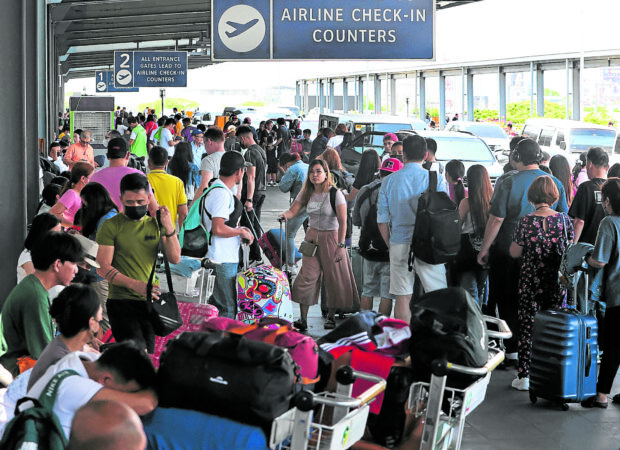
MANILA, Philippines — Senators on Wednesday questioned the abrupt cancellations of flights during bad weather, saying passengers should not have to travel for hours to the airport only to find out that their flights had been canceled.
During a Senate committee on finance hearing on the 2027 spending plan of the Department of Science and Technology (DOST), Sen. Joel Villanueva recounted the experience of his friends from Bulacan who were supposed to take a 9 a.m. flight from Ninoy Aquino International Airport (Naia) Terminal 1 to Isabela.
According to Villanueva, the passengers reportedly left Bulacan at around 4 a.m., only to be told upon reaching the airport that their flight had been canceled due to bad weather.
Even more concerning, he said, is that the same thing happened the following day.
“Imagine, twice po nangyari doon sa mga kababayan doon sa Bulacan na bumiyahe nang napakatagal na oras only to find out na ika-cancel na yung flight,” Villanueva said during the hearing.
(Imagine, this happened twice to our fellow Bulacan residents who traveled for several hours, only to find out that their flight was going to be canceled.)
The senator asked the Philippine Atmospheric, Geophysical and Astronomical Services Administration (Pagasa), which is under DOST, what weather information it provides to the Civil Aviation Authority of the Philippines (Caap) and airlines.
He asked whether it could give sufficient advance warning for flight cancellations to avoid such hassles.
Pagasa Administrator Nathaniel Servando said the state weather bureau provides aviation-specific meteorological services, as well as 24-hour forecasts and three-hour heavy rainfall warnings for the general public.
Lamenting the monsoon rains that happened in August, Pagasa said thunderstorms, particularly during the southwest monsoon, can develop suddenly and be short-lived, making it hard to give notices hours or days ahead.
Pressed regarding how far ahead it could provide reliable information for flight cancellations, the agency said while forecasts are regularly updated, they become less accurate the farther they look.
“Rainfall is really very difficult to predict,” Servando said.
Meanwhile, Sen. Bam Aquino asked whether the country’s technology is at par with other countries.
According to Servando, Pagasa’s forecasting capabilities are comparable with those of other countries given its existing facilities and tools, particularly in tracking tropical cyclones.
Meanwhile, Villanueva said the experience highlighted the need to review policies on flight cancellations and passenger protection.
“Probably that could be a policy reform for the [Department of Transportation], where we require them to cancel certain hours before,” he said.
The senator also raised the possibility of revisiting consumer rights, particularly when passengers suffer losses because of flight cancellations.
Villanueva said he intends to raise the matter to Caap during the DOTr budget discussions.